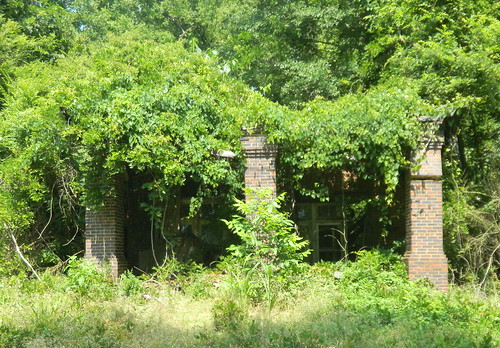
After our Saluda River kayaking trip and post-paddling excursion to Chappells, I became somewhat obsessed with the ghost town and its history. Several left comments on that last post also expressing interest in what happened to the town.
Ghost towns fascinate me. At one time this street was bustling with traffic and activity, and now it’s completely overgrown and deserted. The how and why towns die out are varied, but in this case there are some straightforward reasons why Chappells didn’t survive. It appears that weather and bad luck dealt the worst blows.
Thomas Chappell settled in the area in the 1700’s. In 1756 he requested and was granted permission to build a bridge across the Saluda River to connect his plantation with the Culbreath plantation on the south side of the river. Whether or not that first bridge was ever built is a matter of dispute, depending on the source. If it was built, at some point there was no longer a bridge there, because Chappell began operating a ferry at that location. He built a store nearby, establishing the first commerce in the area. Operation of the ferry and the store were eventually taken over by Thomas’s son, John.
The area was known as “Chappell’s Ferry” through the Revolutionary War and on past the Civil War. In the years after the Civil War the ferry was operated by William Smith, who donated land to (re)built a wooden bridge across the Saluda.
Sometime after the Civil War in the late 1800’s the Columbia and Greenville Railway came through, and instead of Chappell’s Ferry, the area became known as Chappell’s Depot. The thriving community had several stores and commerce was starting to take off when the first of several calamities struck. According to John Abney Chapman in the “Annals of Newberry:”
Efforts have been made to make Chappell €™s Depot, on the G. & C. R. R., a place of business, but with only moderate success. There are some stores there and considerable business is done. On the 19th of February, 1884, the great cyclone or tornado struck it and swept the whole concern away. Some persons were killed and others very seriously injured.
The tornado of 1884 demolished all of the businesses as well as most of the residences. It toppled a train that was also at the depot at the time of the storm.
The town was rebuilt, though. Eventually there were several stores, a cotton gin, post office, and even a doctor and a bank in the area. Unfortunately the area wasn’t done with disasters. Fires in the early part of the 1900’s destroyed some businesses, and other technological factors came into play, as well. In his book “The History of Newberry County, South Carolina: 1860-1990,” Thomas Pope states that “the improved roads then being constructed proved to be the death knell of the little villages” in Newberry County. A 1926 Sanborn Insurance Map of the area indicates several places of business, as well as the depot. However, much of the area is listed as “vacant.”
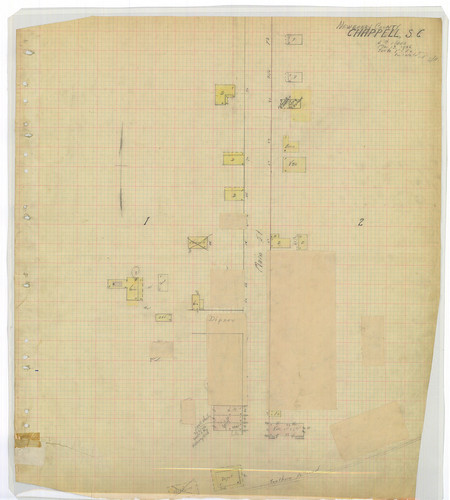
The final blow came shortly after this map was made. In 1926 there was a catastrophic flood that wiped out most of the remaining businesses. In 1929 the bank closed in the midst of the stock market crash. In 1931 Highway 39 was moved to the west and a new concrete and steel girder bridge was built over the river.


This routed traffic off of the old Main Street, effectively bypassing the remaining businesses. Eventually all closed, leaving only the remnants seen today.
I would still love to see some photographs of the town in its heyday. I’ve sent a request to the Newberry County Library, and I spoke with Earnest Shealy from the Newberry County Museum. He gave me a couple of names of long-time residents of the community, and said they might have some old photographs. However, I’m guessing these are not in digital format and probably not readily accessible.
Even though I don’t have photos, there are plenty of online newspaper accounts of what happened. Apparently over its history Chappells was a violent place, and the Chappell family was right in the midst of the fray. In 1867 the Daily Phoenix in Columbia reported a “fatal affray” between “Stanmore Chappell and a man named Payne.” Chappell and “a freedman” were killed instantly. Payne was stabbed by Chappell, and died later.
The Charleston Daily News reported another incident between members of the Chappell family and the community in 1880. Bill Harp made the mistake of winning a cockfight with Press and Jim Chappell. The Chappells didn’t take the loss very well, and started a fight. Harp fatally shot both men in the fray, but was mortally wounded himself.
So, it sounds like shades of the Wild West were present in early Newberry County, too. And, like many of those Wild West towns, nothing is now left of Chappells except a ghost town – an interesting remnant of a wild and woolly time in our state.
Bibliography and Further Reading:
Payne, Thomas H. The History of Newberry County, South Carolina: Volume Two, 1860-1990
O’Neal, John Belton and John Abney Chapman. The Annals of Newberry.
Revels, Jennifer. Historical and Archeological Survey of Newberry County, South Carolina. Palmetto Conservation Foundation.
Shealy, Earnest. WKDK Road Trips
South Carolina Archives – Sanborn Insurance Maps – http://digital.tcl.sc.edu/cdm4/item_viewer.php?CISOROOT=/SFMAPS&CISOPTR=3484
Chronicling America, Library of Congress – http://chroniclingamerica.loc.gov
Chappells Bridge Photos – American Memory Project, Library of Congress –
Great info and story Tom – thanks for digging this one out!
Thanks for posting this. I live in Chappells SC. The only thing I have at this time is a 1900 map of the town. I will be looking for the books you listed.
I’ve been through Chappells many a time and wondered what happened to the town. Thanks for the post – it was very informative and entertaining.
I lived in Chappells, S.C. when I was a child and attended school there. I understand that the school that was used in 1940 is no longer there. I would like to know if anyone has a picture of that school. It seemed to be rather large but only two classrooms were used to house seven grades. It had a library and an auditorium and large kitchen/cafeteria which were not used. The student population was not very large, only three people in my class in the fifth grade.
The school is still there. It’s a community center now. With many pictures of “Old Cgappells” lining the hall way.
I’ve photographed the old school many times, but I didn’t know there were old photographs in there. I would love to visit and view them!
Yes I remember seeing that photo a few years ago that’s where I had to go and vote at I saw that photo with all of that water up to the peoples knees it was on a wall it so shocking to see my grandmother and great grandmother lived there and I had three aunt who also lived there, yes the old school house is still there it is a nice place to go and eat now looks good on the outside and it has great food there we are small but we are still here praise God
When my mother, who was born in 1925, went to that school, there was a tornado one year that took the entire roof off of the school and set it down on the field a mile or so away. Students and teachers were in the building at the time, but no one was hurt. We left Chappells in 1964. My brother and sister and I attended school in Silver Street in Newberry, and the old school and Chappells was serving more or less as a community center. The bookmobile used to pass by there periodically, and I remember my mother taking me there to check out books. I also remember a very long slide that I played on there. The dirt road that we lived on, Blackmon road, was named after my grandfather. Was named after my grandfather. He and my grandmother had nine children, which were used to jokingly say was half the population of Chappells. No descendants live there anymore, although my parents and all of my grandparents are buried in the Chappells Baptist church cemetery.
That school is still there(LARGE BRICK STRUCTURE) and they have had some small reunions….U.S.Post Office is still operational and a nice country store is there also.
Thomas Chappell
Newberry, SC now residing in Greenwood,SC
Hi Thomas,
My Chappells were born in Newberry. I visited Chappells, SC. I was delighted to have my photo taken at the post office. I was a postmaster and a Chappell descendant. My Great Grandfather was James Burden Chappell. I’ve never figured out how or why he got to this “neck of the woods”. From what I’ve read, maybe on the lam? Seriously!
My great great grandfather was listed in the 1870 census as John Chapels a ferryman born in 1830 married to Lucy. Their grandson Will Chappells was my mother’s father he ( Will) mother was Lola Garner.His brother Thomas ran the saw mill in Newberry.
Hi Malcolm, it’s interesting to know that people in this family even care. Thanks for posting. Do you have any history that goes even further back. Pink Wallace? I think is Grandma Eliza father etc etc. what else do you know?
I am a descendant of the Chappell family from Chappell South Carolina . I am part of the family that moved to Alabama . I would love to talk to any of the Chappells i may be related to .
J.B. Chappell
O.B. Chappell
James Wesley Chappell
Thomas Jerry Chappell
Jonathan K Chappell 256-227-4161
Falkville ,Alabama
Hi Kris,
My gg-grandmother was a Chappell and came down to Alabama from S.C. before 1860. We’ve DNA tested and have matches with cousins out of the James Joseph Henry Chappell one of 2 surviving sons of Hix Chappell.
Interested in comparing notes with you.
I found two photo of the school, now a community center, on Panoramio: https://ssl.panoramio.com/photo/9270842
https://ssl.panoramio.com/photo/87080414
Mark, that’s the school I remember seeing, and it’s probably the one Thomas meant. The old two-story school is the one that’s no longer standing.
Thanks so much for finding the picture of the school in Chappells, SC.
My mother was a Chappell & lived there until 1928, when her family moved to Newberry. Her father, John Henry Chappell sold the family farm & whatever business concerns he had there. counsin of mine traced the Chappell line back directly from me to England & France. Our ancester was the Captain of the Speedwell, the sister ship of the Mayflower. A more distant ancester was with William the Conquerer at the Battle of Hastings in 1066. We’re French evidently. Family settled in Virginia in the 1600’s & moved to SC in the 1700’s. I wish my mother had taken me there & shown me around. She would have been 100 yrs. old this year. Thanks for all of the comments & info. It’s greatly appreciated.
My sister and I are the last of the direct Chappell line. I have found some discrepancies in some of your comments and findings. Most of the geneological data that you now have access to today, is that of Robert E. Chappell and then later my father Thomas Henry Chappell son of John Henry Chappell who passed in 1973. Capt. John Chappell of the Speedwell was as far back as he got. As of late, we have finally discovered his father, Sir Robert Chappell of England who orginally came from Ireland. There were cousins in France but nothing direct. So just to set the record straight, we are not french. I am puzzled at who you are and who your mother was. So is my father your cousin?
I believe that you may not be the last. Thomas Chappell may be the grandfather to my great grandfather Tom Chappell iii.
Tom Chappell I know is my great grandfather who was married to Eliza Wallace Chappell.
My mother Lucille Chappell Lindsay’s father was Will Chappell whose mother Lola Garner Chapell was married Thomas Chappell b 1854 whose father John was listed as a ferryman. And a mulato. In the 1870 census.
Very interesting. Looks like we are all related. My Grandmother is Sophia Chappell and Thom and Eliza where my great grand parents. I know certainly that Lola was my great great grandmother. My Grandmother Sophia is the last female of the lineage. Grandma Eliza said she wasn’t a slave and her family came over on a boat from Southern Europe. Cousin Jack got a recording of her in 84 before she transitioned to heaven. I visited the grave sights, saw much of the land that my great parents worked and met some of my great cousins. I went to the elderly home where Grandma Eliza passed away. I had a picture of Grandma Tom. There is one left at Aunt Mutt house on the wall. He is wearing suspenders standing outside. There was one picture of Grandma Eliza circulating when she was in a chair at the elderly home. If anyone has pictures I would truly love to see them.
you are not the last direct of the chappell line…there are many of us. my great grandmother is sara crosby chappell, grew up in the mayfield plantation house.. her father was charles thompson chappell…i am also a direct decendant of capt. john chappell is he 12x my great grandfather…
(i am 20 years old)
*mayfair plantation, sorry!
do you know how many children the chappells had? to think that you are the only two direct decendants is absurd…my family has the entire family tree starting from capt. john chappell’s grandfather mapped. and also, captain john chappells father isn’t robert chappell, robert chappell is his grandfather.
Pleaseeee let me have this. There are so many. Grandma Sophie had 13 children. All except 1 lives in the DMV. I have contact and can connect you to the entire family from MD and DC. There where many Chappell’s back then. There even spelled differently so maybe she is speaking bout another family. Grandma Eliza and Grandpa Tom had many children also.
The catchy thing is that there are many Toms with the same many John’s as father and son followed by the same many last names. I only wish we had pictures to know what was which. I know my dad talks about my great grandfather being a farm worker. My grandma makes it very clear they weren’t slaves and the family came on a boat from Southern Europe.
I am a descendant of the Chappell family from Chappell South Carolina . I am part of the family that moved to Alabama . I would love to talk to any of the Chappells i may be related to .
J.B. Chappell
O.B. Chappell
James Wesley Chappell
Thomas Jerry Chappell
Jonathan K Chappell 256-227-4161
Falkville ,Alabama
Hi Jean!
I had Chappells and Hasels from SC. Relatives?
Betty
You must be Hazel Wright I was one of your classmates You hit me in the head with a bat when we were playing ball out front
My family are slave descendants from/very near Chappells. (Moon) Oddly, your research on this town and the other side of my family (Lost Towns/Atomic Towns) who are from Meyer’s Mill, have helped me trace my family history very far. If you have any information on township of “Moon” it would be awesome. I have traced it to of course Dr. Peter Moon and have seen his slave schedules but didn’t know if you had any pictures, geographical coordinates etc…
Hi, I am a Moon descendent also. I am looking for information on Anderson Moon, my maternal grandfather, whom my mom never met. He was born around 1911 and spent a year working in Westfield, NJ in 1929-1930.
I have lots of info on Anderson Moon. Reach out to me and I’ll share what I found.
Prophecylives@gmail.com
My name is Malcolm Lindsay Allen . My greatgrandfather Henry Lindsay lived in Moons he had 13 children wound up in Lauren’s and then Cincinnati, Ohio in 1918 1919. The Lindsay’s Hailstocks, Davis ‘s the Cannons in South Carolina in Greenwood and Cincinnati are the same.
Do you have any information on the Reeders, Browns and Simpsons that grew up on the Moon’s Plantation? I am trying to research the area to find information on my lineage. Thanks, C Simpson
My friend owns a couple hundred acres in Chappells. In the middle of the property there is a very old graveyard from the 1850s and beside the graveyard has a plaque that says something about a Moon community house. You can see the old foundation from the structure. I will have to take a picture of it next time I’m that way. There are also some Harmons buried in the cemetery which caught my attention. Elizabeth C Harmon (died 8/2/1851) daughter of John L Harmon.
Im from Chappell and remember some of the old structures . Seems like it use to be a very thriving community. I grew up there in the 1980s
My father’s family was from Chappells. We loved the little town. We played in the cotton warehouse and roamed through the woods. In the summer we picked blackberries. We swam in Lake Greenwood. It was a great place for kids!
I was raised in Chappells and truly miss the country living…There’s nothing on earth that compares to it…we lived down a dirt road not far from the post office..played in the creek behind our house and was even able to drink from it back then..I’m 50 now and really miss the good times in Chappells…
I am 50 and grew up in Chappells. I lived there from 1966 to 1988.The dirt road you grew up on is Blackmon Rd. As a boy I worked at the country store beside the post office.
Blackmon Road is named after my grandfather, who build a house on that road. I lived there in that house and Chappells from age 3 to age 8, moving to Columbia in 1964 with my parents. I have amazing memories of the years that I spent there, and my parents and all of my grandparents are buried in the cemetery at Chappells Baptist church.
Are you related to Jay and Jimmy Blackmon ? Use to play down there
Yes I remember seeing that photo a few years ago that’s where I had to go and vote at I saw that photo with all of that water up to the peoples knees it was on a wall it so shocking to see my grandmother and great grandmother lived there and I had three aunt who also lived there, yes the old school house is still there it is a nice place to go and eat now looks good on the outside and it has great food there we are small but we are still here praise God
Musta been Mr Wertz store Use to eat lunch with sawmill workers next to it
My name is Ed Calvert Lived on what is known as Long Road now from 40 till 59 and played in the creek behind Grandmas house out on highway
Have you seen this book? It mentions Chappells. https://books.google.com/books?id=wtI_XUGVp90C&pg=PA20&lpg=PA20&dq=1900+map+newberry+sc&source=bl&ots=2NH7o21-8F&sig=l2CwV9CEGG6PLGXPjcuBLJm-WvI&hl=en&sa=X&ved=0ahUKEwiU1PbdkZrSAhUKOSYKHZIjD9c4KBDoAQgbMAA#v=onepage&q=Deadfall&f=false
They are constructing a Dollar General store directly across from Post Office… A resurgence may be forth coming…We will see.
I know hopefully they will leave the house alone
My name is Jonathan Daniels my grandfather is Thomas Henry Chappell son of John Henry Chappell this whole town is named after my family and I’m very glad to see its history preserved on the internet .
Hi Jonathan,
I’m from the Chappells there! We are probably related. I’m on ancestry and have DNA done. My Great Grandfather was James Burden Chappell. Have any photos?
Betty
My family lived at Dead Fall (George Lucious Ligon Brooks family) and at Chappells (the Foshee family). My great grandfather Eugene Hamilton Foshee died in 1945 from kidney cancer. He was a dairyman there. His first wife was Nelle Margaret Ward. She was killed by a broken back in a car accident in 1929. If I remember correctly, they slammed on brakes and a hog in the back of the truck came through the back window and killed her. Eugene H. Foshee’s mother was Sara Frances (Fannie) Davis. I would like to know who his father was and anything about these people that anyone knows.
If anyone has any information on Crossroads Baptist Church established in 1814 I would love to know all can I am part of the rebirth of this church… a new pastor has taken over and we had one living member as of Sunday past we now have 19… We are planning a fall festival in Nov 2018 and I’d love to put together a history presentation
What is the building out on Hwy 39 with the skulls painted in each upper corner of the front of the building? Looks freshly painted. building is solid white and the windows are blacked out. Passed by it two days ago (11/22/18). Looks very strange. Like a cult or White Supremist gathering hall. I could be way off so don’t crush me if its a local quilting group meeting hall.
Not sure what it is now, but it used to be a bait shop called “Crenshaw’s”. The bait shop owner put the skulls there, but they deteriorated. A storm wiped out the last of them.
Does anyone information about an old grist mill located just south of Chappells? I believe there is a Church still there called Chestnut Baptist. A very old cemetery is located there. There is a creek that runs along side of it and the mill was located on that. Any help would be greatly appreciated. Thank you
I am a direct Chappell family member from .. I am the 6th generation to breed the family Chappell Doms gamefowl .. I am from the ones that moved to Alabama. Looks like I have family I never knew of .. This is awesome family history .. Thank you
Kris Chappell
Chappell Doms since 1855
Please contact me if you are a direct descendants of the chappells .
I have proof . 256-227-4161