I was doing some research for a podcast episode on the town of Lando in eastern Chester County, South Carolina when I stumbled on an interesting tidbit that sent me down a rabbit hole. The town of Edgemoor is just north of Lando, and Richburg is to its south. I wanted to find out more about these two towns and how they related to Lando.
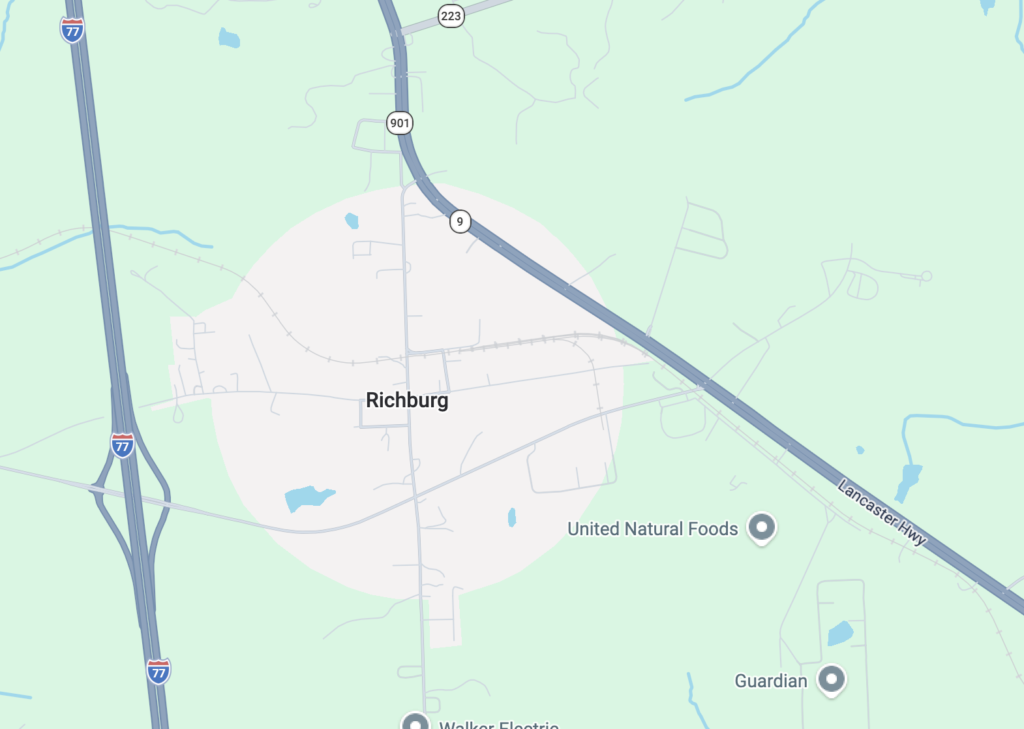
When I looked up info on Richburg I came across this information on SCIWAY.net…
In the mid-1800s, a New York preacher with followers all along the East Coast made predictions that the world would come to an end on March 15, 1843. Believers in Chester County selected a high elevation from which to watch the cataclysmic event. They built temporary shacks and waited obediently for the appointed day to come.
Only the rich could afford to stop work and live on accumulated supplies of food. The less wealthy people in the community were scornful and called the settlement of shacks “Rich Hill.” When the night of March 15th passed without incident, the followers lost faith in their prophet. By then, however, they’d found Rich Hill to be a pleasant place to live. They began to construct permanent homes.
South Carolina already had a town by the name of Rich Hill, in Lancaster County, so when a post office was established, the name of the town was changed to Richburg.
A weird doomsday cult in South Carolina? Associated with a small historic town? Yes, please! This rabbit hole dive would lead me to the origins of several modern sects, as well as serve as a cautionary tale on multiple levels.
Apart from SCIWAY, the only other place I’d seen this history of Richburg’s name was on a Stucky’s website, of all places. It repeated the same story elements. My first task was to see if I could find this anywhere else. My initial search turned up nothing apart from these two references. So, I turned my attention to the cult leader.
The only information I had was “New York preacher” and the date, March 15, 1843. Searching for the terms “apocalypse” and “1843” started me on the right path. I’d made an assumption that this was a South Carolina cult. When I looked back and saw that the article said that “followers all along the East Coast”, I expanded my search and found the answer.
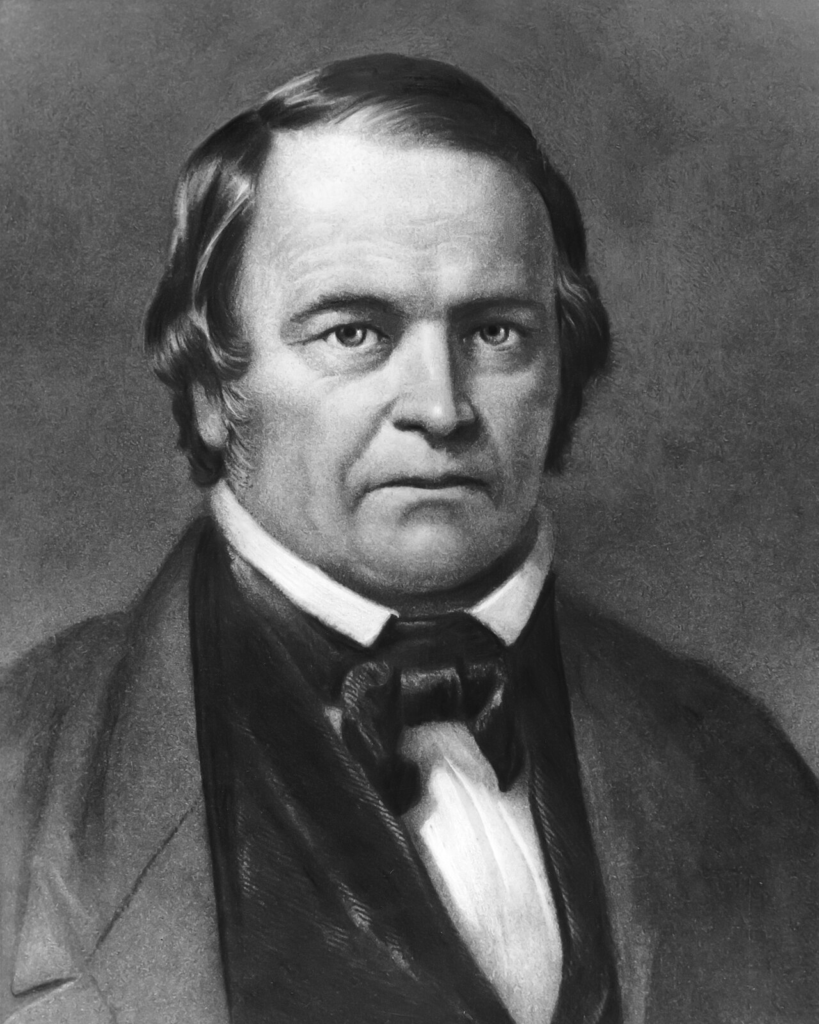
Reverend William Miller was born in 1782 in Massachusetts. He was raised in rural New York, and was a veteran of the War of 1812. During the Battle of Plattsburgh he came under bombardment and considered his survival a miracle from God. After the war he moved back to New York and settled on a 200 acre farm and was ordained as a Baptist minister.
Through the course of his ministry, Miller became interested in eschatology. The Book of Daniel held particular fascination for him. By analyzing Daniel’s “weeks” he felt that he had come up with a date for the end of the world. He placed his date somewhere between March 21, 1843 and March 21, 1844. So, he allowed himself a year of leeway.
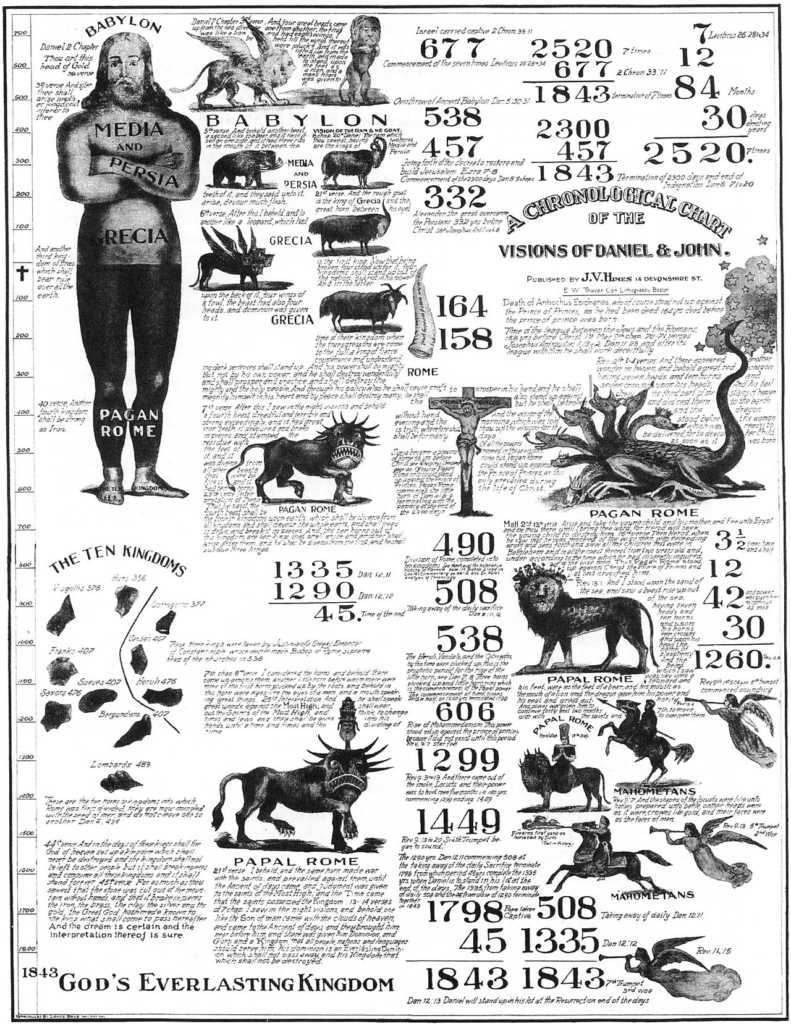
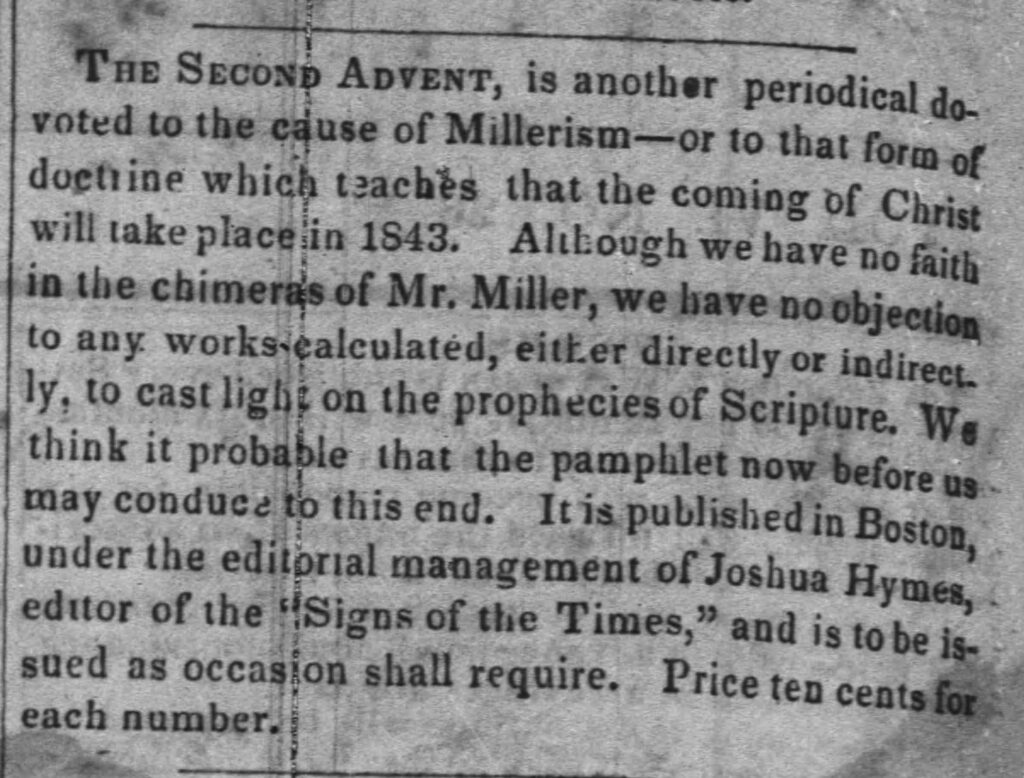
Miller’s prophesy took off in the 1830s and he began publishing a newsletter called Sign of the Times. Through this he gained followers all along the east coast. Millerism gained popularity and the followers were called Millerites.
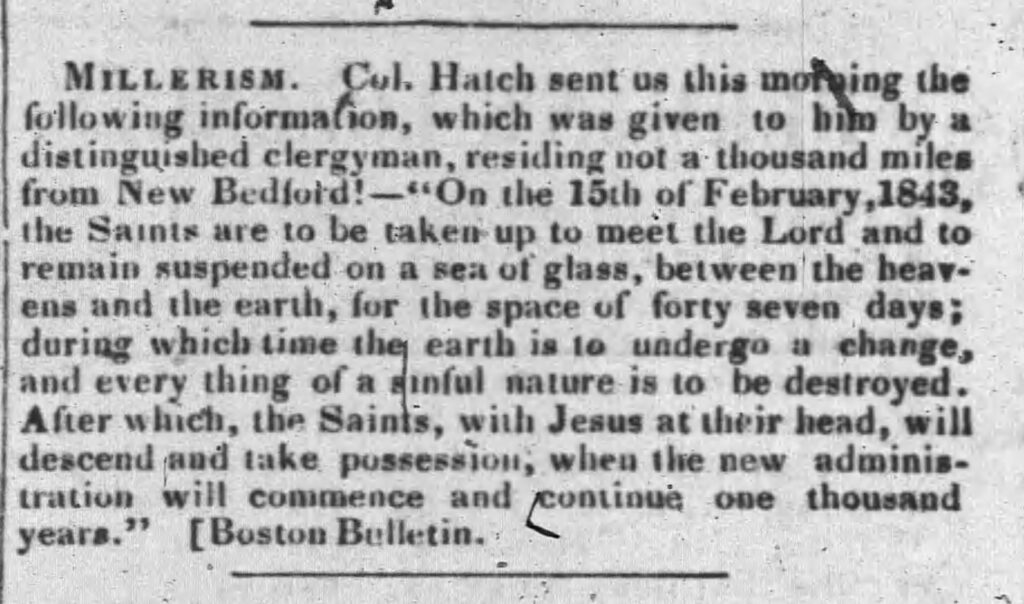
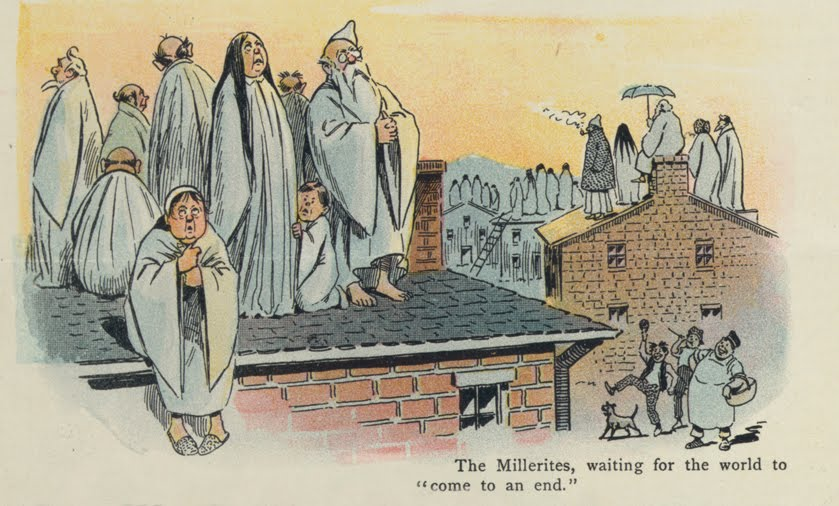
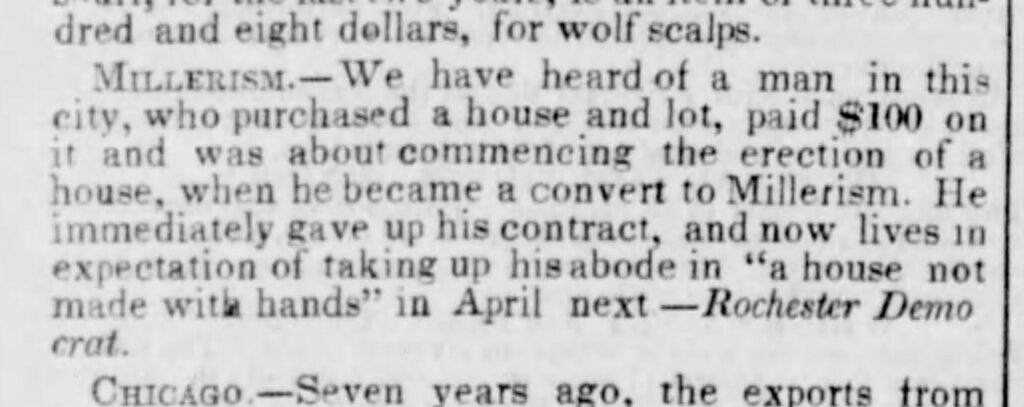
As with so many end-of-world sects, it was reported that Millerites sold their possessions because they would not be needed. They gathered on hilltops and donned white “ascension robes” and awaited the end.
1843 came and went. Miller reset, saying that he made an error and that he should have followed the Jewish calendar.
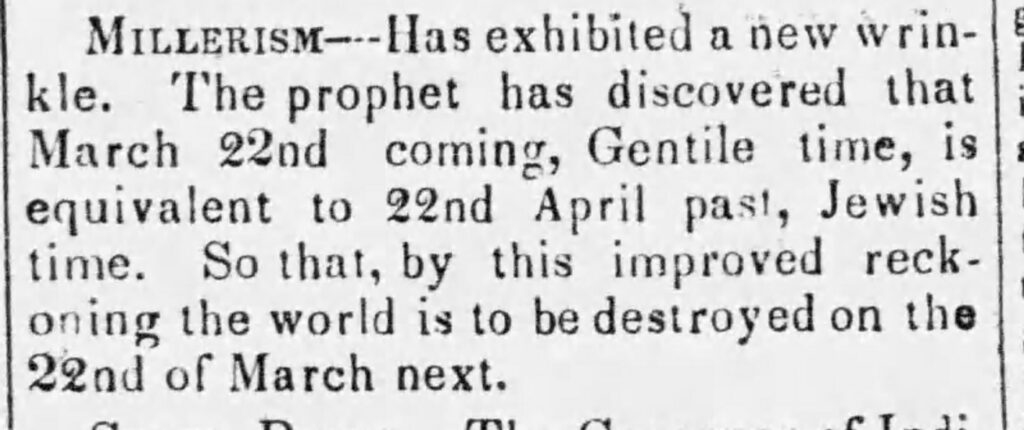
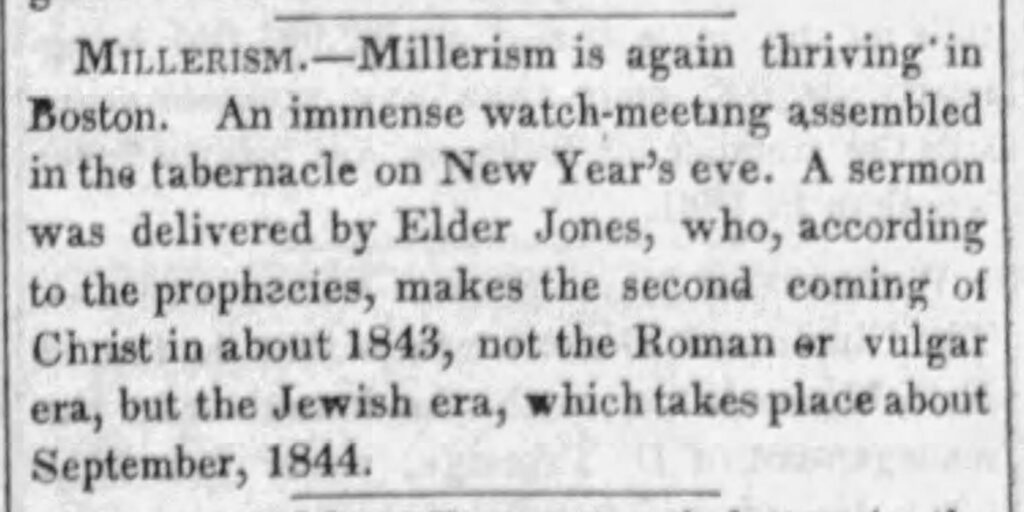
By October 1844 Miller accepted that he was wrong. His followers fell into what became known as the Great Disappointment.
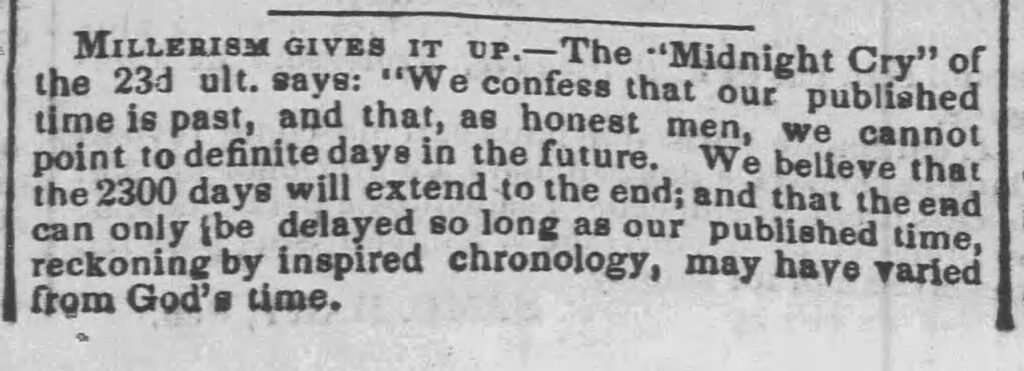
Miller died in 1849. Despite the disappointment and Miller’s death, Millerites continued to look forward to the advent of the Lord. They took the name Adventists, and continued with the idea that the Lord’s return was imminent. Three modern day sects can trace their origins back to Miller and to the Adventists. These are the Seven-Day Adventists and their Davidian off-shoots, Jehovah’s Witnesses, and the Baháʼí Faith.
So that’s Millerism in a nutshell. The question is, did Millerism reach all the way down to Chester County in South Carolina? All of the resources I’ve found say that it’s quite a stretch. In the first place, Millerism was inclusive of both blacks and whites, which probably wouldn’t have gone over in the Antebellum South. That doesn’t mean that an exclusively white group couldn’t have bought into Miller’s theology, but enough to settle a town? When I queried an AI it said that there were maybe 10 adherents in the state. Take that for what it’s worth.
I did a bit more digging and was able to find more references to “Rich Hill” and the Millerites. The story shows up on the Roots and Recall website and in several more modern news articles. Most of these repeat the same details as the SCIWAY information.
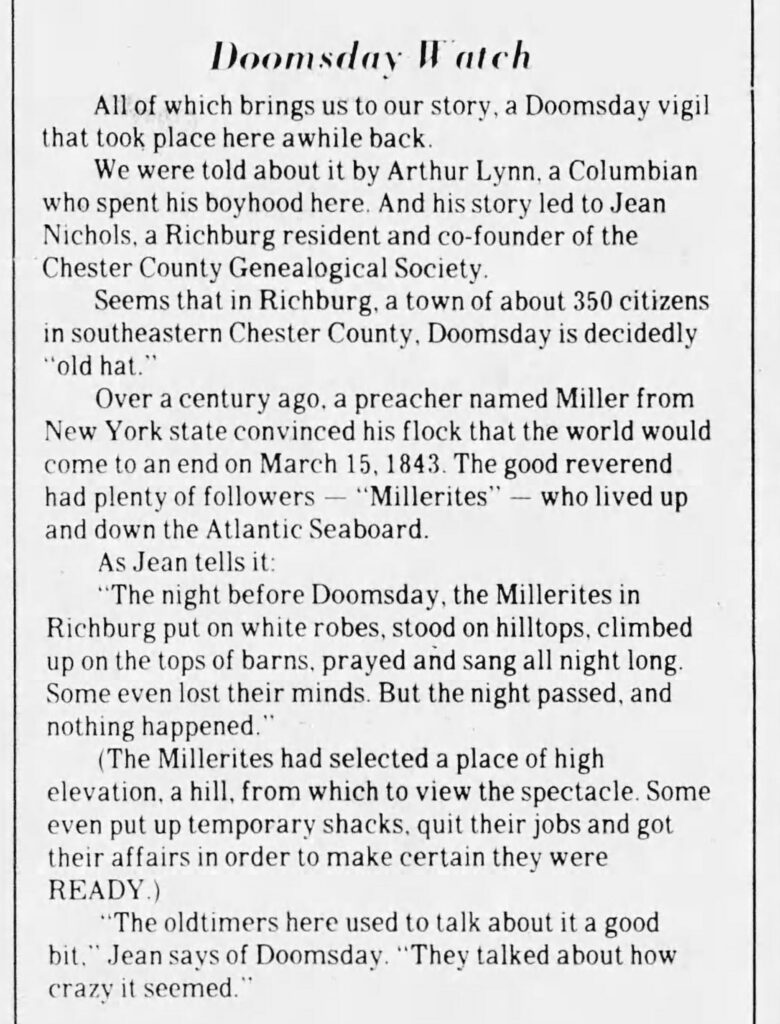
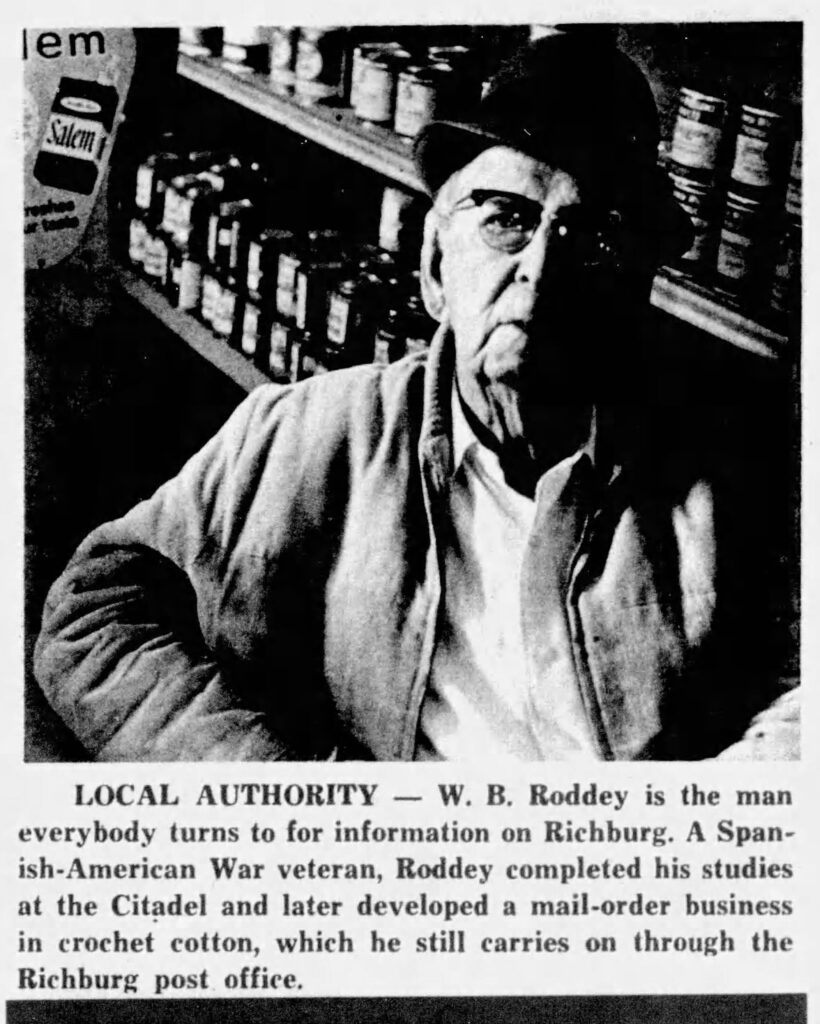
One of the “oldtimers” mentioned in The State article from 1982 is Wade B. Roddy. Many of the later articles reference a 1968 article by Roddey.
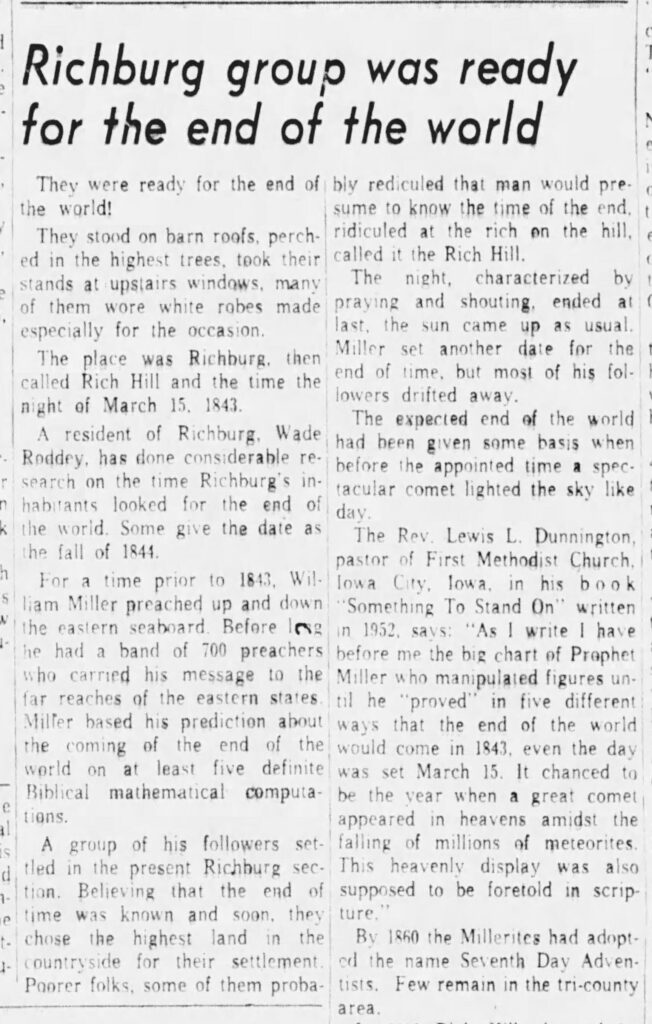
However, I found another article dating back to 1960.
I finally found a 2009 quarterly report from the Chester County Genealogy Society. The article was authored by Winthrop historian Louis Pettus. I’ve quoted her before in both my podcast and on this website, so I consider her a reliable source. She repeats the Millerite origin story for Richburg, but with a caveat.
And who were the Chester people of Rich Hill? According to the census of that time along with other known details they were people by the surnames of Barber, Anderson, Kee, Wylie, Millen, Stroud, Crockett, Hicklin, McFadden, Drennan and Ferguson. All ofthese names were prominent in the Presbyterian Church. Could it have been that they had switched their allegiance? Did a Millerite preacher pitch his tent amongst these stalwart Presbyterians and convert them? Or, were the Rich Hill Millerites newcomers to the area? We don’t know.
We do know that such camp meetings were not foreign to these people. Across the river in the Waxhaws there was a Great Revival in May 1802 that had drawn between three and five thousand people, including Baptists and Methodists as well as Presbyterians. One of the outcomes of the Waxhaws revival was a splitting of the Old Waxhaw membership in which a number withdrew and set up the Associate Reformed Presbyterian (ARP) Church.
There doesn’t seem to be a record of what has been called “The Great Disappointment” that would tell us how the Rich Hill people reacted. Elsewhere it is said that “Many had sold their homes and failed to bring in the harvest from the fields. Every hope was centered in the soon return of Jesus. That night, many spent the entire night in bitter weeping and returned the next morning to their villages to meet the jeers and laughter of their neighbors.”
William Miller then stated that he had made an error-that the date should have been six months later. Failure for the second time didn’t stop Miller. He helped to establish the Adventist Church which believes in the second coming of Christ but does not specify the date.
Pettus makes an interesting point that the early settlers were Presbyterians and not Millerites. So far I haven’t found the names of any individuals from Richburg identified as followers of Millerism.
None of the articles I read that describe this history of Richburg include documentation. For me that’s a red flag. I went back to the news articles to see what I could find. I found lots of contemporary articles from South Carolina talking about William Miller and Millerism, but these were always about some other state or location. There was nothing about Millerism in Chester County.
Instead of Millerism, I started searching for “Rich Hill” and Richburg in articles from 1835 until 1845. According to Carolana.com, the Rich Hill post office was established in 1855, and it’s name was changed to Richburg in 1879. That’s much later than our story. I was able to find an article that backs up the date of the change.
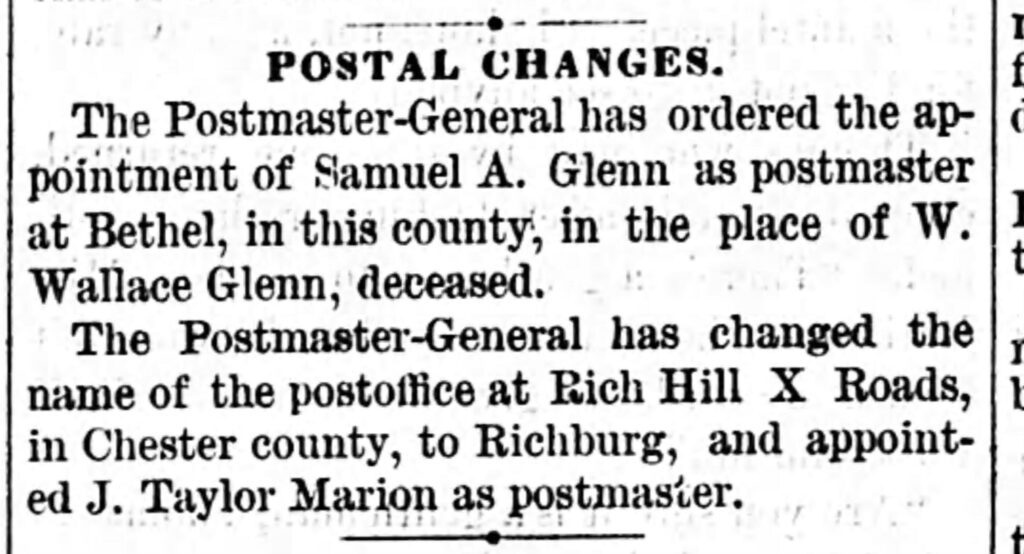
I started searching for Rich Hill and Rich Hill Cross Roads. I came across several “Rich Hills” in the state, which is why the name was changed to Richburg. The earliest mention of Rich Hill in Chester County was in the Edgeville Advertiser from 1838. The article was in reference to a House resolution appointing a justice for the town.
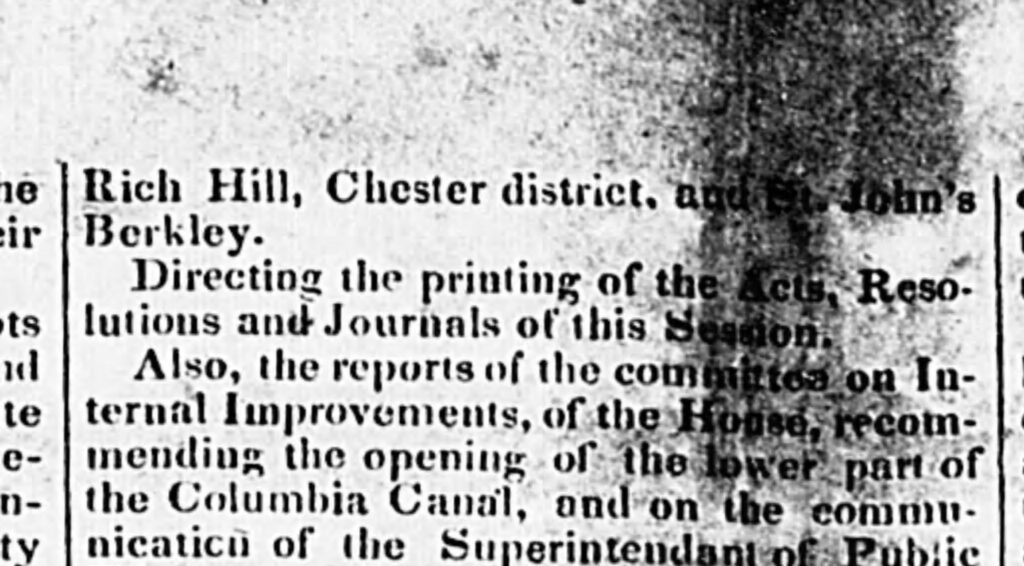
This predates the Miller end times date by five years. That’s a long time to be hanging out in a shanty town waiting for the end of the world.
Conclusions
Were a group of Millerites responsible for the name of Rich Hill in Chester County? Probably not. At least, the evidence I’ve found so far doesn’t support it. Here’s why I say that…
- The most prominent, and probably richest settlers were all Presbyterian. There is no evidence that they were Adventists.
- There are no Adventist churches in the area.
- Contemporary papers make no mention of Millerites in South Carolina at all.
- The name “Rich Hill” predates the Millerite event by at least five years. It was established enough by that time to have a justice appointed by the legislature.
- The earliest mention I can find for the story is 1958, and that provides no documentation.
If there were any Millerites in the area at that time, my guess is that there was probably a small group of a few people and that the tale grew taller with the telling. If someone has some documented evidence to the contrary, I’d love to see it.
So, I have two cautionary tales from this research. First, don’t just repeat “tradition” as fact. Find documentation. This same story has been repeated on websites, in news articles, and in otherwise respectable resources. Second, don’t ever join a doomsday cult.