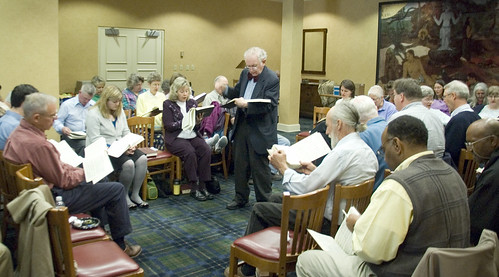
Saturday morning I attended the William Walker Memorial Singing at Wofford College. William “Singing Billy” Walker was the publisher of The Southern Harmony in 1835 and Christian Harmony in 1866, as well as a composer of many of the tunes found in these. He was a native of Union County, but lived and worked in Spartanburg. He was also the brother-in-law of B. F. White, publisher of The Sacred Harp. The singing is an annual event at Wofford to honor Walker.
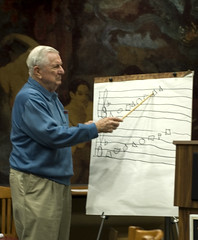
I arrived early enough for the Singing School portion, where we learned about the various shaped note systems. The Southern Harmony and the Sacred Harp both use similar four-shape systems, with syllables running from fa-so-la-fa-so-la-mi-fa for a major scale. Walker expanded to a seven-shape system for the Christian Harmony which more closely matches the do-re-mi scale with which I’m familiar. The singing would start with songs from Christian Harmony until lunch, then songs from The Sacred Harp for the rest of the day. Weather permitting, the plan was to go out to Walker’s grave and sing a couple of songs to end the singing.
I had brought my copies of The Southern Harmony, Christian Harmony, and The Sacred Harp. I found that these were the wrong editions and wouldn’t work for this singing. Fortunately, they had loaners and had new books for sale. I opted to purchase the correct versions so that I wouldn’t look like a rube at the next singing. I had also brought the camcorder and audio recorder, and set those up in a corner so I could record the proceedings. I also had my camera with me for some still shots. One way or another, I was going to record this thing.
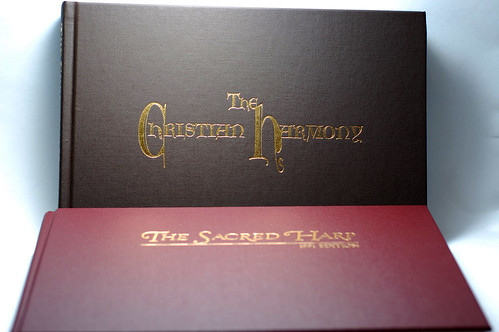
The singing was well-attended, with about 50 singers at its peak. The chairs were arranged in the familiar “open square” configuration, with each voice part on a side and the song leader in the middle. A “chairman” was elected for each session of the singing, who would announce the names of the next song leaders and keep the singing moving. The leader would come forward and announce the song. A pitch was given (which may or may not match the actual printed pitch), and the group sang through the song on syllables first, the with the text.
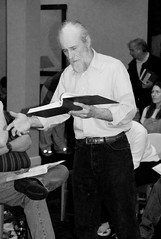
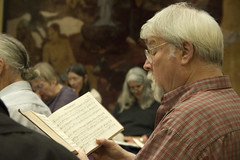
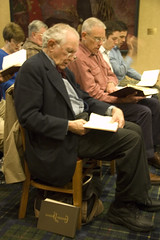
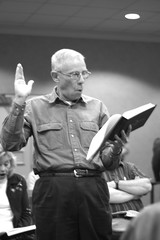
The facility was very nice and comfortable, but it was totally inappropriate for this type of music. To me, this music should be sung in a more primitive setting with better acoustics. While it was fun, and the folks at Wofford were gracious hosts, it just didn’t have that same authentic feel as the singing I attended in Owings last fall.
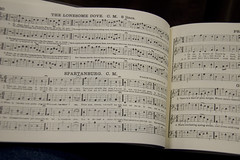
Despite the problems with the setting, I stayed for the entire event. There were a couple of significant happenings. First, part of the singing instruction was done by Hugh McGraw, a Sacred Harp expert who has several tunes published in the 1991 Denson Edition of that book. Also, we sang the tune “Spartanburg” by William Walker. It turns out that Walker wrote the tune on March 15, 1873, exactly 125 years ago to the day.
The weather didn’t permit going out to Walker’s grave, so we wrapped things up at Wofford. The last bit of business was announcements of upcoming singings. For most of these, they would announce which tune book would be used, and the dates were always something like “the last Saturday of March” – rarely an exact date was given.
As I said earlier, it was fun, but not quite what I expected. Furman is having a singing in the next couple of months, but it will be very similar to Wofford’s sing. I really need to find one of these that will be held in some little white frame church out in the middle of nowhere. Now that would be more authentic.
[tags]singing, Sacred Harp, Southern Harmony, Shaped Note, William Walker[/tags]
There aren’t many singings in “little white frame churches” in the Carolinas. But there are plenty in Georgia. http://www.atlantasacredharp.org/ One great place to sing is in Historic St. John’s Episcopal on N. Main Street in Rutherfordton, NC. There are Christian Harmony singings there every October and December. See http://www.christianharmony.org/
That’s what I was noticing. It did look like there were some good singings in Georgia, and I may try to go to one.
Thanks for the links!
Don’t be too quick to discount the Furman University Singing (May 10). I go to A LOT of shape note singings in very primitive locations and its not always about the acoustics or the quaintness. Its usually about the singers. And there are some very fine singers in the Greenville area (these were the folks you encountered at Owings). The Furman singing is one of my favorite combined Christian Harmony and Sacred Harp singings. (And the room they use has great acoustics.)
Thanks for the input, Jane. I had already thought I might go to the Furman Singing just for comparison.
I sing in Harper Hall every Monday evening, so I’m quite familiar with the setting. The acoustics are good.